Most teams use only a fraction of what their CRM can do. The system gets set up, is half-adopted, and ends up being more of a burden than a tool that powers deal and fundraising activities.
The key features and benefits stay on the table, while the admin is still done by hand, deals and relationships aren’t captured, and the reporting is built in Excel instead.
Here’s what it should actually be doing:
Request a free consultation with our senior advisors. Get insights on how your peers are using their CRM, and what it would take to get your system working optimally for your team.
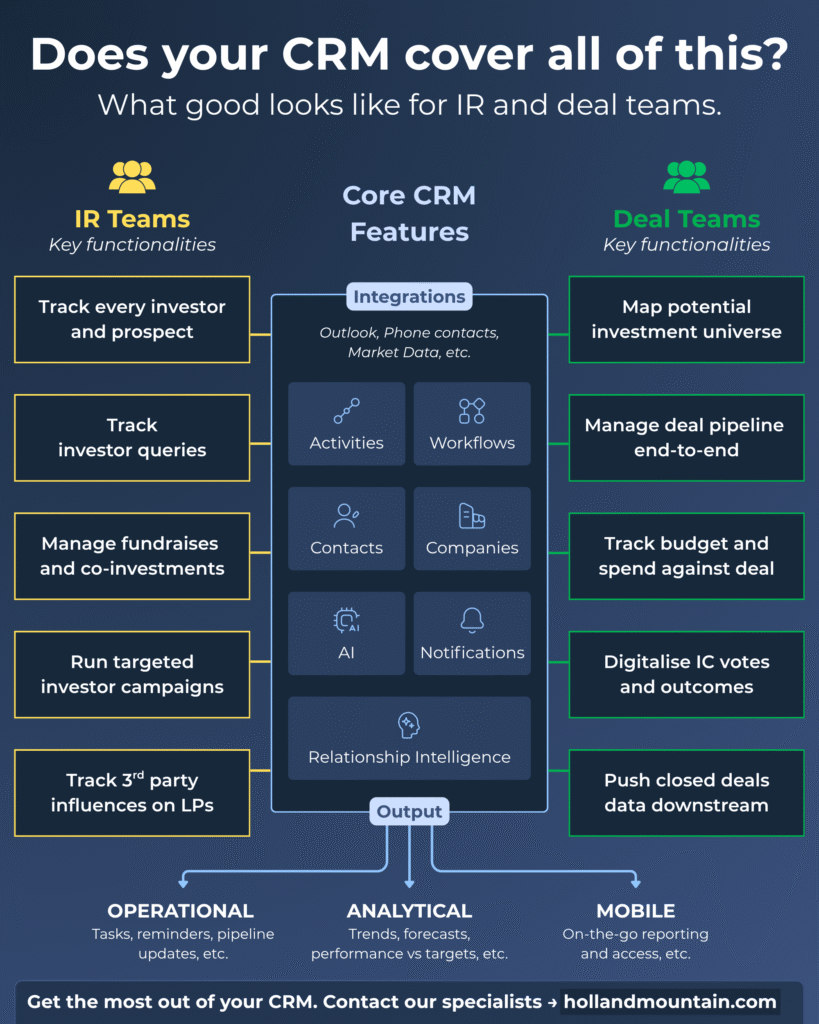
Integrations: minimize data entry
An optimized system should minimize data entry and be well-integrated.
The less that’s entered by hand, the more the system is worth and the more it’s adopted by teams, because the data stays current and can actually be relied on.
- Emails and meetings log themselves from Outlook
- Company and market data are pulled in from sources like PitchBook and Preqin
- Contacts stay up to date, so when someone calls, the team knows who it is
If contacts are still being added one at a time, that’s time and information lost every week.
Everyone is working from the same picture
When everything sits in one place, the whole team works from a single source of truth.
- Activities: contacts, companies, and interactions are logged automatically
- Contacts and companies: a single source of truth for deal and IR teams
- Workflows: recurring processes run the same way each time, with steps, approvals, and reminders built in
- Notifications: the team is alerted to what’s changed and what needs attention, without having to go looking
- AI: works on top of complete, connected data to surface insights and cut manual effort
- Relationship intelligence: anyone can see who across the firm already knows a given person
Together, these build the firm’s own proprietary intelligence: recorded, retained, and ready to act on.
Key functionalities for IR teams
A CRM should give IR teams a real-time picture of every investor relationship and its status.
| 1) Track every investor and prospect | Who they are, what they’ve committed, and where the conversation is up to, in one place |
| 2) Track investor queries | Every request is logged and owned, so nothing gets forgotten, and response times are visible |
| 3) Manage fundraises and co-investments | Soft commitments, allocations, and where each investor sits in the raise, all visible as it moves |
| 4) Run targeted investor campaigns | Reach the right investors and see who’s actually engaging, so follow-up goes to real interest |
| 5) Track 3rd-party influence on LPs | The gatekeepers and consultants behind each investor, and whether they decide on allocations or just advise, so it’s clear who really shapes a commitment |
Key functionalities for deal teams
A CRM should carry a deal the whole way, from first look to after it closes.
| 1) Map the potential investment universe | A live list of the companies and sectors worth watching, long before any of them come to market |
| 2) Track every deal sourced | Every opportunity and where it came from, including the intermediary who brought it, so it’s clear which relationships are actually generating deals |
| 3) Manage the deal pipeline end-to-end | Every live deal, its stage, and its next move, with the whole team looking at the same pipeline |
| 4) Digitalize IC votes and outcomes | Run IC in the system instead of over email: papers, voting, and decisions in one place that can be looked back on |
| 5) Integrate closed deals downstream | Hand a closed deal to whatever comes next without re-keying it, so nothing gets lost at the finish line |
What a CRM should give back
In practice, that’s three important outputs:
- Operational: what teams work off day to day: tasks, reminders, live pipeline changes
- Analytical: the bigger questions asked now and then: how the pipeline is moving over time, how a raise is going versus the last fund, which advisers give back as much as they receive
- Mobile: the same access on a phone, so a deal can be checked or a meeting logged between meetings
Seeing where your firm stands
Request a 30-minute consultation with one of our senior advisers. Get insights on how your peers are using their CRM, and leave with practical improvements you can action straight away.
In 30 minutes, you’ll get straight answers to:
- How much of the CRM’s potential is being used today?
- How to make the most of the new AI functionality?
- What would it take, in effort and cost, to get the system working the way the team needs?
- Which reporting peers are driving from their CRM?
- Which systems are winning selections today, and why?
More about Holland Mountain’s CRM and pipeline advisory services.