The fund administration market has evolved considerably. Technology-enabled operations, NextGen automation, and data-driven service delivery are now active areas of investment for leading administrators — driving greater efficiency, scalability, and service consistency.
For GPs, this creates both an opportunity and an imperative: to maximize the value of their outsourcing relationship, whether benchmarking an incumbent against today’s market or exploring the latest generation of providers. This question belongs on every CFO’s agenda — and our 2026 Fund Administrator Market Map below is a good place to start.
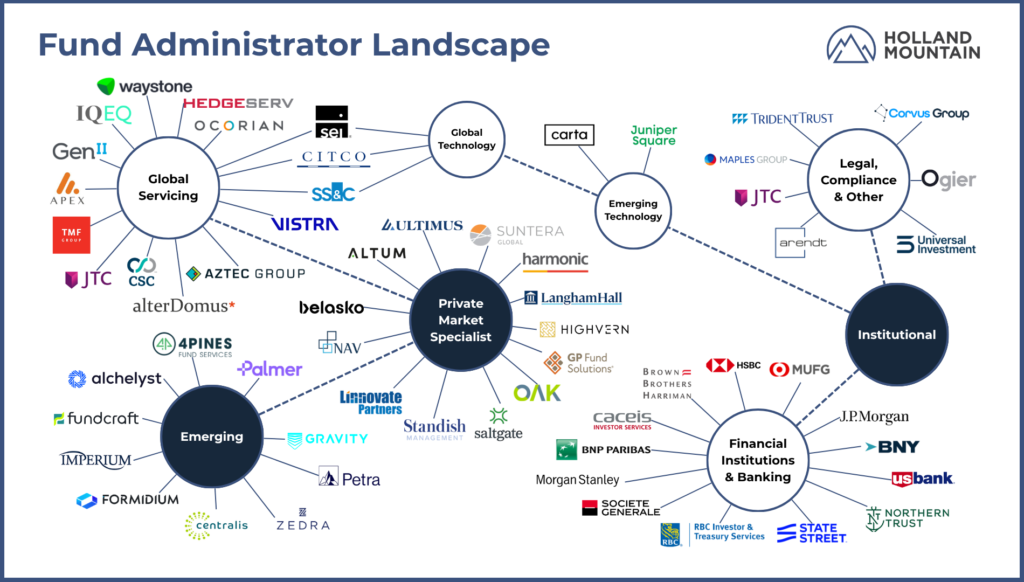
Download the 2026 Fund Administrator Market Map →
The fund administration market moves quickly, and we are committed to keeping this map as current and comprehensive as possible. If you feel a provider should be included or repositioned, we welcome your input at research@hollandmountain.com.
At Holland Mountain, we help clients optimize their outsourcing strategy. Through our experience of managing dozens of RFP processes for private capital firms, we have identified five key considerations CFOs should address to maximize the success of their selection process — spanning market landscape, internal alignment, investor expectations, and the selection process itself. By addressing these, firms can ensure they partner with a fund administrator best suited to support their operational and strategic goals.
1. Understanding the evolving fund administrator landscape
Each fund administrator has their key differentiators, sweet spot, and business value drivers. It is important to have an extensive view of their strong suit and how it best aligns with your requirements. When working with GPs, we typically support their market understanding by focusing on four key trends:
- Market Consolidation: The fund administration landscape has undergone significant consolidation in recent years, with over 30 M&A transactions and lift-outs recorded since 2022. Administrators are pursuing scale to deliver greater efficiency and broaden servicing capabilities — but large-scale organizational change can introduce material risks, including integration challenges, inconsistent service delivery across operating platforms, and disruption to BAU operations. For GPs, staying informed about their outsourcing partners’ organizational trajectory has become an increasingly important component of effective oversight.
- Evolution of market incumbents: The functional offerings and technology capabilities of fund administrators continue to evolve in response to shifting market dynamics, regulatory requirements, and changing client demands — including emerging fund structures such as ELTIF & LTAF, alongside developments in tokenization, data infrastructure, and AI adoption, are increasingly shaping competitive differentiation across providers.
- Emerging, challenger firm: Every now and then, there will be new, emerging fund administrators entering the market, by establishing their initial presence as niche service providers offering bespoke, specialized services to cater to clients’ specific nuances, bridging the gaps in the standard service offerings of the larger, institutional service providers.
- Geographical Expansion: Fund administrators are also constantly expanding into new locations through organic growth, M&A, lift-outs, or partnerships, enabling them to scale along with existing clients while acquiring new clients in regions previously beyond their reach.
The selection of a fund administrator has now become a more diverse process, with GPs navigating a broader range of provider options than ever before. With four distinct trends reshaping the market, firms that have not conducted a structured market review in recent years may find their understanding of the landscape outdated or incomplete — emphasizing the importance of informed market insight ahead of any selection process.
2. Looking externally: what is considered best practice?
While every firm’s outsourcing model reflects its own investment strategy and growth ambition, there are common best practices we consistently advise across private capital firms.
In an ideal outsourcing model, GPs should seek to minimize or fully eliminate reliance on shadow bookkeeping, allowing internal teams to focus on higher-value tasks and strategic oversight, supported by technology automation and data solutions via:
- Evaluating the level of data access provided by the fund administrator on their GP portal, enabling clients to monitor and review data in a timely and transparent manner, while allowing them to extract data for self-reporting — addressing the immediate need for visibility without significant parallel shadow operations.
- Implementing an internal data platform that feeds data regularly from fund administrator(s), with rules set up to automatically flag for data exceptions while allowing clients to retain full ownership of data. This supports both vertical consolidation — multi-layered data look-through from portfolio investment to investor level — and horizontal consolidation across front, middle, and back-office systems, providing greater control and a single source of truth.
Beyond data, we are also seeing a broader shift in how GPs manage their administrator relationships — moving from transactional arrangements towards more strategic, dialogue-based partnerships. A key enabler of this is appointing a centralized relationship manager or oversight team, responsible for:
- Centralizing and monitoring internal requests, communication, and interactions from relevant teams for any feedback and challenges
- Undertaking structured, periodic reviews of the quality of the fund administrator
- Leveraging the fund administrator’s platform to track feedback in a timely manner, ensuring review sessions are data-driven
- Proactively tapping into the administrator’s subject matter expertise on regulatory developments, market practice, and broader strategic initiatives such as fund structuring and fundraising
During a selection process, we provide independent insights on both elements above — including peer feedback — to ensure clients have the confidence to make an informed appointment decision.
3. Looking internally: alignment of internal stakeholders
When advising clients on selection, we often emphasize the importance of aligning priorities internally and understanding the actual bottleneck in the previous outsourcing model.
- Priorities: Each stakeholder may have a different view or focus within an outsourcing relationship, leading to different expectations of an ideal administrator, e.g., having global presence, core competency and quality, investments in technology innovation, and how they would be able to add value as a long-term strategic partner. Aligning the key priorities of each stakeholder group is crucial before initiating the selection process.
- Challenges: The challenges GPs face with fund administrators may typically arise for multiple reasons. Some are driven by internal changes, resulting in outdated SLAs with incumbent administrators due to legacy requirements or processes. It may require an independent, objective review of the existing process to identify the root causes and corresponding next steps, to ensure the changes with new administrators are effective.
Having a project sponsor before and during the selection process ensures a responsible party takes ownership of the project, documenting the priorities and preferences of multiple stakeholders, and being able to translate that into a set of requirements for the fund administrator.
4. Meeting investors’ expectations
Fund administration fees are typically charged back to the funds, making it crucial for the administrators’ service quality to be well-reflected in the information that LPs receive. In today’s environment, where investor experience holds increasing importance, there are two critical areas where your fund administrators must excel:
- When a fund administrator manages investor servicing processes, ensure LPs receive comprehensive guidance on using supporting tools. Effective communication and responsiveness to LP queries are essential. Providing clear instructions and resources helps reduce friction and enhances the overall investor experience.
- Fund administrators that demonstrate flexibility in supporting bespoke investor reporting requirements are often value-adding. This includes accommodating specific types and levels of data, providing reports at the desired frequency and in the preferred format, and utilizing automated reporting tools to ensure efficient information delivery. At a bare minimum, the administrator should be capable of providing GPs with the required set of data to support the reporting.
5. Preparation for selection and RFP process
After carefully considering the elements above, private capital managers should incorporate them when preparing their RFP and managing the selection process end-to-end.
GPs will usually go through a process to shortlist their options towards the most ideal administrator. When done well, a comprehensive process enables CFOs to select their best fund administrator, minimizing the risk of missing inputs and ensuring the decision is future-proof.
However, there are also challenges during the selection process that CFOs should be aware of:
- Limited internal resources to run the selection process may distract staff from core and valuable tasks and disrupt BAU operations
- Not having a full picture of the ever-growing fund administrator landscape may restrict options
- Lack of internal alignment and buy-in may delay and muddle the objectives
- Process deficiencies in assessing and evaluating options may undermine the success of the selection
- Unaware of best practices on appropriate pricing may result in an unfavorable commercial outcome
How to minimize the risk of missing things and ensure selection success?
Our clients typically engage Holland Mountain to manage the process end-to-end — reducing the burden on internal teams while maximizing the likelihood of finding the best-fit administrator.
Holland Mountain’s Fund Admin RFP Process is a bespoke and proven approach for each client. It provides up-front advice to help them overcome challenges when considering a fund administrator selection while providing an end-to-end, managed solution.
Holland Mountain is a trusted partner with extensive experience managing dozens of RFPs for private capital firms representing over $1tn in AUM. Our broad experience in private capital operations allows us to specify the challenges firms face, both with the fund administrator and internally, ensuring the change does not just stop at changing a service provider but prompts institutional change for operational efficiency and scalability.
Our selection services are structured to deliver value directly to the fund — and as a result, our fees can typically be charged to the fund rather than absorbed by the management company.