AI has moved fast this year, with implementation and experimentation running across the industry. And the question now sitting on every executive’s desk: what are we getting back for the spend?
It is a harder question than it looks, because the technology is becoming the easy part to get hold of. Buy it or build it – the tools are within reach of everyone.
In this trend report, we share what we are seeing across the private capital firms we work with, and where we would point firms next, so they can sharpen their roadmap without letting costs run away.
When everyone can hold the same AI tools, where do the differentiators actually come from, and what keeps ROI on track to deliver real business results?
Jump to trends:
- Buy, build, and now open source?
- The rising cost of AI
- AI & Fund Administrators
- Data quality moves up the agenda
- Prioritizing AI use cases
- MCPs and the single source of truth
- Conclusion
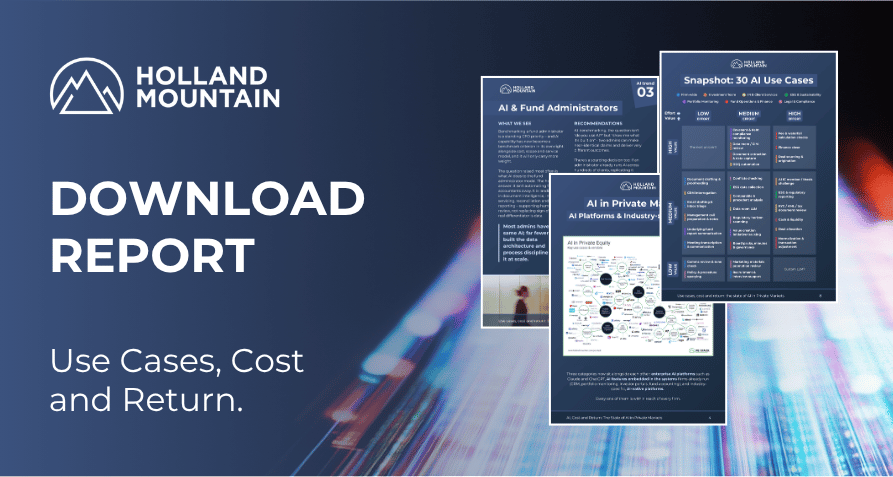
Download this content as a report with an AI vendors map and 30 prioritized use cases →
1. Buy, build, and now open source?
What we see
The last few years brought a wave of AI point solutions to private capital – 100+ vendors at the last count.
What’s shifted more recently is the instinct that came with them: rather than buy, more firms started asking why they weren’t building it themselves.
And now, very recently, a third option has appeared – open source. A library of ready-made AI agents and use cases has just been published openly in our market, free to use.
If AI can be built within reach or simply picked up for free like open-source agents, then the tools won’t be the advantage.
Everyone can hold the same tools; what separates them is the potential to exploit them – the data, the track record, and the relationships a firm overlays on top, most of it unstructured and sitting inside the business.
Recommendations
Think twice before pouring months into building agents to own IP that’s on its way to being free. Where the market already sells a mature tool, the workflows and interface around the AI are the hard part, and firms routinely underestimate the cost of matching them.
One scenario worth holding: as the true cost of generic AI becomes clear, the best point solutions may pull ahead again within 12–18 months.
Neither build nor buy is the default.
ROI considerations
If accessing, buying, or building AI is within everyone’s reach – and open source now puts the agents themselves on the table for free – the return no longer comes from the tool. It comes from how well a firm’s data feeds it and how well its people use it.
2. The rising cost of AI
What we see
Generic AI felt cheap as a handful of seats on a monthly subscription. It isn’t staying that way.
As usage spreads, the bill climbs fast and quietly.
We see firms running up tens of thousands a month without quite realizing it, much of it usage they didn’t need. Some of that is by design: providers encourage you to do more, because more usage suits them.
Part of it can also come down to duplication – across a firm, the same use cases are often being worked out more than once, teams spending tokens on problems colleagues have already solved, similar prompts rebuilt in silos with little shared or consolidated. Some of that reinvention is avoidable.
Recommendations
The fix isn’t complicated, but it needs an owner. More firms now run usage dashboards – who’s using what – so the bill doesn’t arrive as a surprise.
Visibility is only the start; the bigger lever is how people use it.
Two people can get the same result from the same task, and one costs ten times the other, simply from how they ask, or from requesting a full slide deck they never needed.
Cost-efficient prompting, taught and reinforced, lowers the bill and improves the output at the same time.
And the duplication is worth tackling head-on: capture what works once – as shared skills, prompts, and agents the whole firm can reuse – rather than letting every team rebuild it and pay for the privilege.
ROI considerations
AI cost is variable and monthly, so ROI is never fixed at go-live – it drifts. Someone has to keep asking whether the return still holds.
Used frivolously – or rebuilt ten times over in ten corners of the business – the spend erodes the very return it was meant to create.
3. AI & Fund Administrators
What we see
Benchmarking a fund administrator is a standing CFO priority – and AI capability has now become a benchmark criterion in its own right, alongside cost, scope and service model, and it will only carry more weight.
The question raised most often is what AI does to the fund administrator model. The honest answer: it isn’t automating fund accountants away, whatever the marketing implies. It is landing first in document intelligence, investor servicing, reconciliation and reporting – supporting human review, not replacing sign-off. The real differentiator is data.
Most admins have the same AI; far fewer have built the data architecture and process discipline to run it at scale.
Recommendations
At benchmarking, the question isn’t “do you use AI?” but “show me what it’s built on” – two admins can make near-identical claims and deliver very different outcomes.
There’s a sourcing decision too: if an administrator already runs AI across hundreds of clients, replicating it manually in-house rarely pays. It’s not automatic – it holds only if their governance, controls, and data quality stand up.
Source AI deliberately, rather than defaulting to internal by habit.
ROI considerations
A capability delivered at scale across 100 clients will typically outperform the same capability built once, for a single firm, making in-house replication a duplicated cost.
4. Data quality moves up the agenda
What we see
We often write about this, and finally, the get your data in order message has landed. What’s changed is that it suddenly bites: firms are getting disappointing results from their AI and working out why.
The AI tool isn’t the problem; the input is.
It shows up on both sides of the data. On the structured side, the platform isn’t mastered or complete enough for the model to trust it.
On the unstructured side – diligence files, monitoring, everything that never reached a system – the material either isn’t fed in at all, or only half of it is, so the model works from a partial picture and the output shows it.
Recommendations
Fix both. That means a properly mastered data platform the model can rely on as a single source, and the unstructured material captured and organized across SharePoint so tools can find the right, current document.
Get there, and the gain is more than better answers – it opens up use cases previously out of reach.
Your AI is only ever as good as what you feed it.
ROI considerations
Firms are already paying for the models – feeding them a half-picture is the fastest way to depress a return already committed to.
5. Prioritizing AI use cases
What we see
As AI usage matures, the use cases themselves are becoming common knowledge – the hype is receding and a shared, practical picture is taking its place.
We’ve now identified 70+ mature use cases across private capital, and most firms actively use fewer than 5% of them.
They don’t carry equal effort: roughly a quarter need very little investment to get going, another quarter delivers their full value only with a solid operating model underneath, and the rest sit in between.
Recommendations
Don’t chase the whole list, and don’t start with the hardest. Sequence by dependency: bank the low-effort wins first, and treat the complex, high-dependency cases as things earned once the foundations are in place.
Effort-to-value is the lens.
ROI considerations
The easy cases deliver measurable benefit quickly and are simple to demonstrate; the transformational ones repay only if the operating model can carry them.
Access our library of 70+ AI use cases

Click here to request access to the library
6. MCPs and the single source of truth
What we see
As firms wire AI into their systems, the point solutions are all building their own MCP connectors. The temptation is to plug the model into each one – but wire in five connectors and the model is drawing from five sources at once.
It can no longer tell the golden source from the noise.
Drawing from five sources removes any way to tell the AI what’s valid and what isn’t, and quality suffers.
Recommendations
Aim MCPs at the data platform for structured, properly mastered data, and at a well-organized SharePoint for the unstructured side – one authoritative picture to work from.
Building that golden-source logic across every connector is possible – but it’s permanent maintenance, and it breaks every time something changes.
ROI considerations
Every integration into an app you’ll swap out inside a year is cost you won’t recover.
Integrating once, at the platform, turns MCP into a scalable operating model rather than a standing maintenance bill.
Conclusion: The advantage comes from the operating model and data
Every trend here points the same way. AI is becoming more widely available; models are cheaper to reach and easier to misuse; use cases are increasingly public.
What doesn’t commoditize is a firm’s operating model, its data, its governance, and its processes – the ground everything else stands on.
Get that wrong, and the smartest AI on the market still underdelivers. It was never about the tool, but how it is used.
The same applies to whom a firm brings in.
The AI consulting market has filled up fast, but generic AI expertise on its own adds little. The value lies in knowing how AI is prioritized, governed, and applied inside a private capital operating model.
Which is why ROI has become the thread running through all trends. Any technology or change now needs more than a business case.
Show the intended outcome and how it will be measured.
Quantify the time a task takes today, set a target for how much a change should cut it, tie that to headcount or redeployment, and write trackable KPIs.
With one large Private Equity client, we did exactly that: quantifying time on specific tasks, setting a measurable reduction target, tracked before and after. And the governance has to keep running after go-live – otherwise the benefit quietly dies at the finish line and all that’s left is dozens of pilots.
ROI from AI is never fixed.
The technology keeps improving, so the thinking should too; if the return isn’t climbing, that’s usually the sign the governance and continuous-improvement effort aren’t there.
Put someone behind the data and AI effort to own exactly that – and only then is a firm set up to exploit AI properly.
Realize the benefits of AI with Holland Mountain
AI delivers results only when it’s built on the right operational, technology, and data foundations. Holland Mountain helps private capital firms maximize the value of their AI investments with the structure to govern and institutionalize them.
Whether you’re scaling AI pilots, strengthening governance, or looking to achieve quantifiable AI benefits, our experts can help.
Contact us to speak with one of our Private Markets AI advisors.