Every year, private capital firms come to us for help selecting a portfolio monitoring solution.
Reporting requirements are more frequent, LPs are requesting more granular information, and investment strategies are becoming more complex. The pressure on portfolio monitoring and operations teams has increased considerably, and the trend is not reversing.
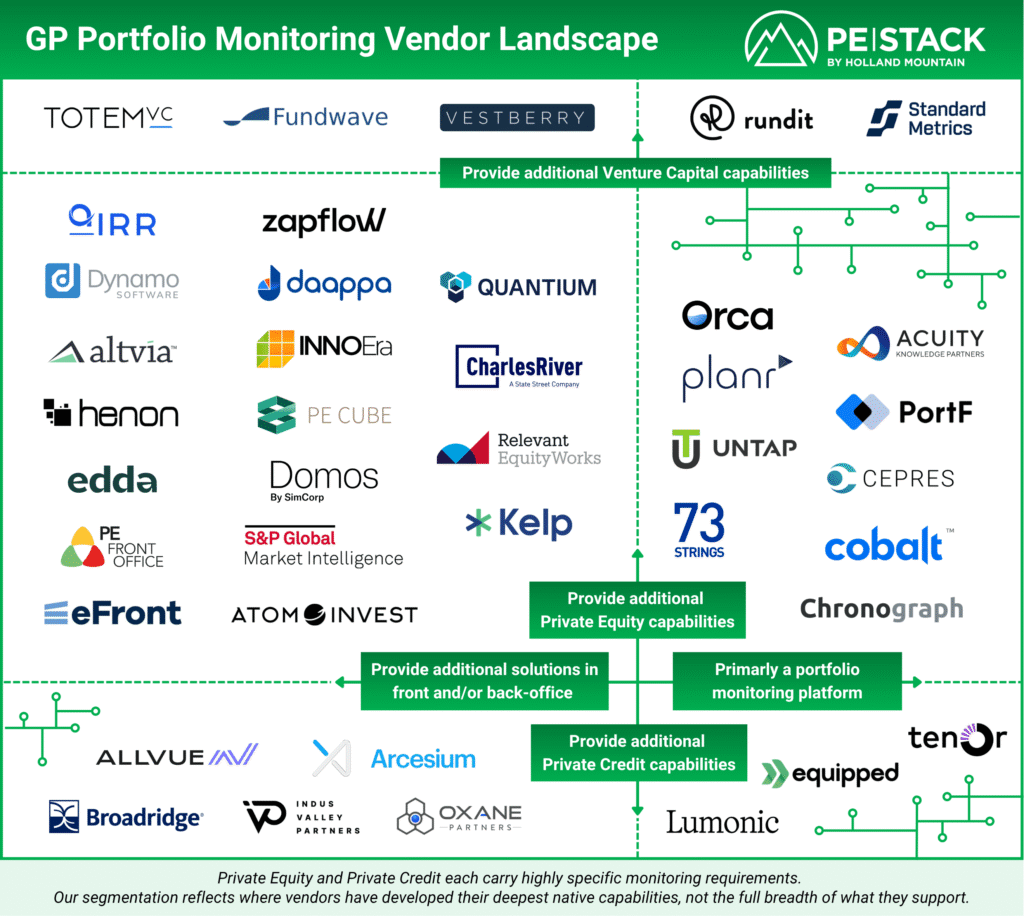
At the same time, there are now over 40 vendors in the market that can support fund managers (this vendor map focuses only on PMS for GPs with direct investments), each built differently and positioned for different use cases. Identifying the right fit takes more than a feature comparison.
With constant vendor development and innovation, mapping the portfolio monitoring landscape is challenging. While we do have criteria to determine map positioning, any omissions are likely unintentional, and we encourage you to contact info@pestack.com to request any changes or additions to the map.
Download this map in high-resolution >>
What the Map Shows
The 2026 map features 40 vendors, reflecting the market’s maturity and continued momentum. New entrants are arriving from two directions: purpose-built monitoring platforms developed from the ground up, and established enterprise software providers extending their suites to include portfolio monitoring.
Private Equity vs. Private Credit: a meaningful distinction
Most vendors began in either private equity or private credit and have since expanded across asset classes – but their origins still influence how their platforms are built.
PE-focused tools are typically designed around periodic portfolio reporting and valuation, and while they can collect borrower financials, they’re not inherently structured for continuous credit risk monitoring. Functions like covenant compliance tracking, credit-specific KPI analysis (e.g., liquidity, leverage headroom), and forward-looking risk exposure require a different data model, calculation layer, and alerting logic than traditional PE workflows.
As a result, the distinction isn’t just about access to data, but about how that data is interpreted and acted upon. If your Private Credit monitoring needs extend beyond aggregation into automated analysis, exception-based reporting, and real-time flagging, a purpose-built credit solution is typically the better fit – though some newer platforms are beginning to bridge that gap.
PM-only platforms vs. enterprise solutions
Dedicated PM platforms typically offer greater monitoring depth and faster product development cycles. Enterprise solutions offer consolidation advantages, particularly for firms already embedded within that vendor’s ecosystem.
What we consistently observe is that neither model is inherently superior – the right answer depends on your existing technology footprint and integration priorities.

Start With Your Own Requirements
In our experience, the firms that navigate vendor selection most effectively start with internal clarity before engaging any vendor:
- Strategy fit: Does this solution support your current asset classes, and the ones you plan to add?
- Tech stack alignment: Does it integrate with your existing back-office and systems used by your fund administrators?
- Ecosystem thinking: Does it complement your broader technology stack, or introduce additional complexity?
- Functionality: Can the system deliver on its core purpose and support your more complex use cases? How confident are you that it will drive meaningful efficiency gains?
It is also worth noting that modern data platforms have significantly lowered integration barriers. Best-in-class point solutions can connect effectively without sitting inside the same vendor suite. The question is fit, not completeness.
Pricing Is More Flexible Than Initial Proposals Suggest
When evaluating the right tool, it’s important to look beyond the licensing fee and consider the broader cost of ownership. This includes understanding whether additional features or enhancements will come at extra cost over time. As vendors continuously evolve their platforms, you’ll want to ensure you can benefit from ongoing improvements without incurring incremental fees.
There are four cost components that firms should account for:
- The platform licensing fee
- Implementation fees
- Third-party advisory costs for firms engaging external expertise during selection or implementation
- Ongoing vendor or third-party support for the day-to-day management of the tool.
At the same time, consider whether the pricing model aligns with your growth strategy, as this will directly impact the total cost of ownership. Vendors typically charge using one of two approaches:
- AUM-based pricing: Scales with fund size, which can be more predictable for stable or slower-growing strategies
- Portfolio company-based pricing: Works well for concentrated portfolios, but costs can increase quickly as you add more investments
Selection Differentiators: What Actually Makes the Difference
Selecting a portfolio monitoring solution is ultimately more about your firm’s specific needs than any vendor’s feature list.
Having supported 50+ selection and implementation processes across private capital firms, Holland Mountain has identified the criteria that consistently make a difference for your private equity peers during selection.
If you are a fund manager and want to learn more about the key differentiators, reach out to our team.